



The main areas of the state policy in the electric power industry are developed and determined by the Government of the Republic of Kazakhstan. The Ministry of Energy of the Republic of Kazakhstan is the authorized state body responsible for administration in the electric power industry. Supervision and control in the electric power industry are exercised by the state authority, the Committee for Atomic and Energy Supervision and Control of the Ministry of Energy of the Republic of Kazakhstan.
The Committee for the Regulation of Natural Monopolies of the Ministry of National Economy of the Republic of Kazakhstan is a state body that carries out control and regulation of activities classified as falling within the sphere of state monopoly (including the activities of the joint-stock company “Kazakhstan Electricity Grid Operating Company” (KEGOC JSC) as a natural monopoly entity).
Industry structure
Within the existing model of the electric power industry, the following key levels are distinguished:
- Electricity generation – carried out by power plants of various types (thermal, hydroelectric, renewable energy facilities) owned by state and private companies;
- Electricity transmission through trunk power grids – carried out through the National Power Grid, which provides the connection between the country’s regions, power plants and large consumers, as well as cross-border electricity flows;
- Operational dispatch management – centralised management of the operating modes of the Unified Power System of the Republic of Kazakhstan, the balancing of electricity production and consumption;
- Distribution of electricity – carried out by regional electric grid companies over distribution networks;
- Consumption – by industrial enterprises, infrastructure facilities, small and medium-sized businesses and the population.
Electricity generation sector
Electricity generation in the Republic of Kazakhstan is carried out by 248 power plants of various forms of ownership. The total installed capacity of the power plants of the Republic of Kazakhstan as of 1 January 2026 is 26,807.0 MW; the available capacity is 20,081.0 MW (the available capacity of RES (SPP, WPP, small HPPs) is indicated in accordance with the methodology for compiling the forecast balance of electric capacity: dam-free run-of-river HPPs – 30 %; WPP – 20 %; SPP – 0 % of the available capacity).
Electricity generation in the Republic of Kazakhstan in 2025
| Power plants | Installed capacity, MW |
|---|---|
| Thermal power plants, total: | 20,525.9 |
| Steam-turbine, including: | 17,753.5 |
| pulverised coal | 13,679.0 |
| on gas and fuel oil | 4,074.5 |
| Gas-turbine | 2,772.4 |
| Wind power plants | 2,071.0 |
| Solar power plants | 1,353.0 |
| Hydroelectric power plants, including: | 2,856.0 |
| small | 321.2 |
| Biogas units | 1.1 |
| TOTAL | 26,807.0 |
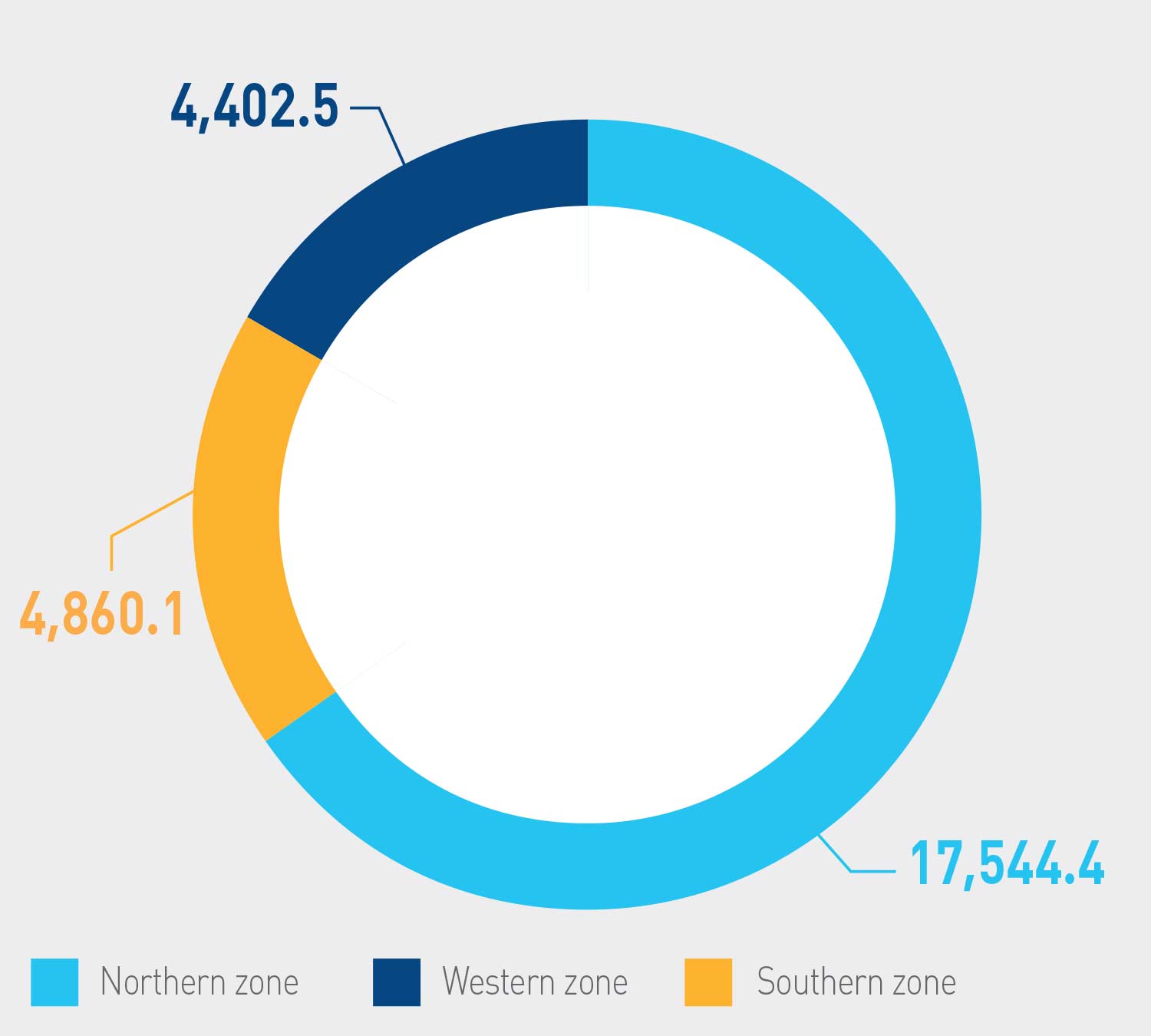
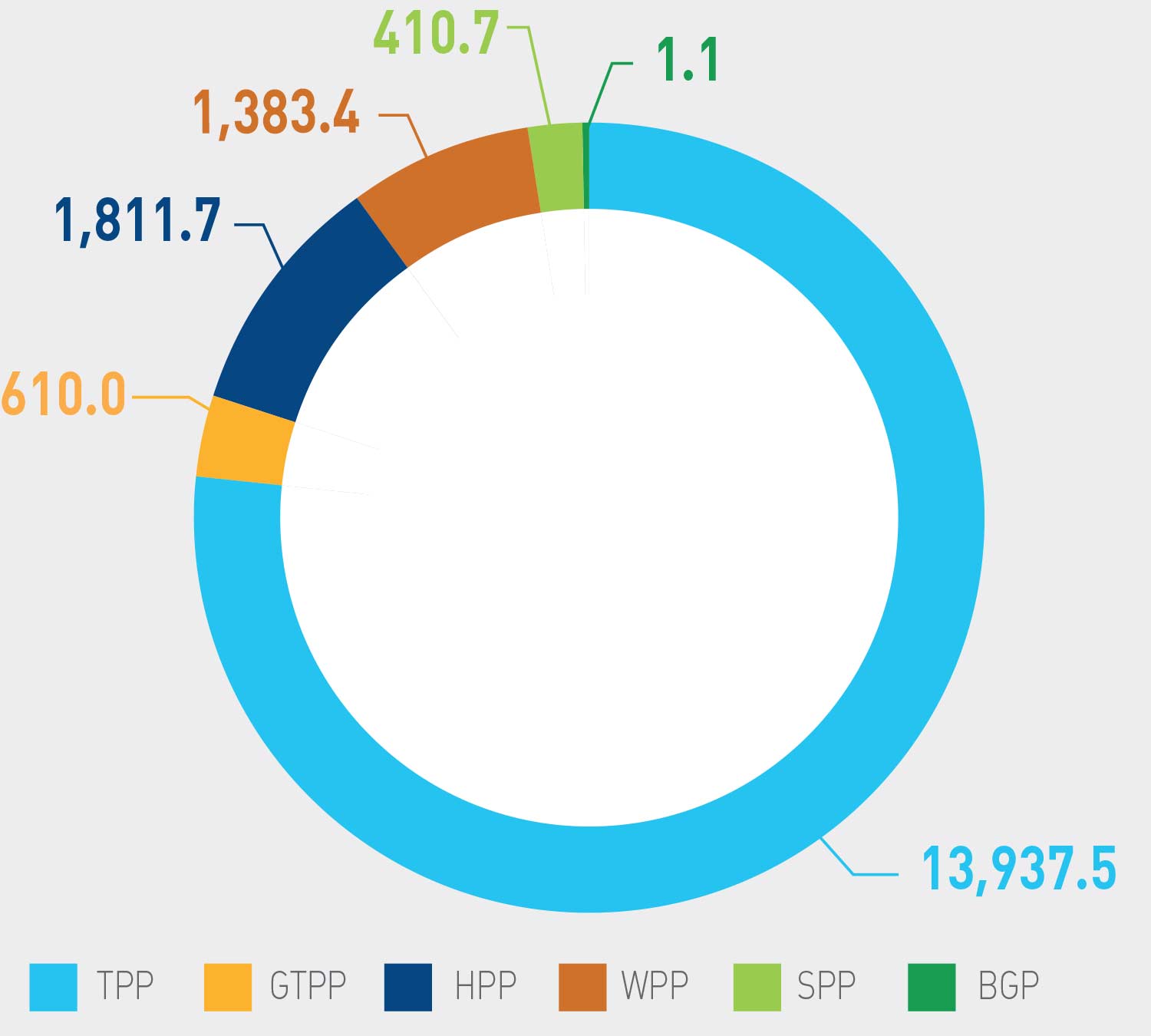
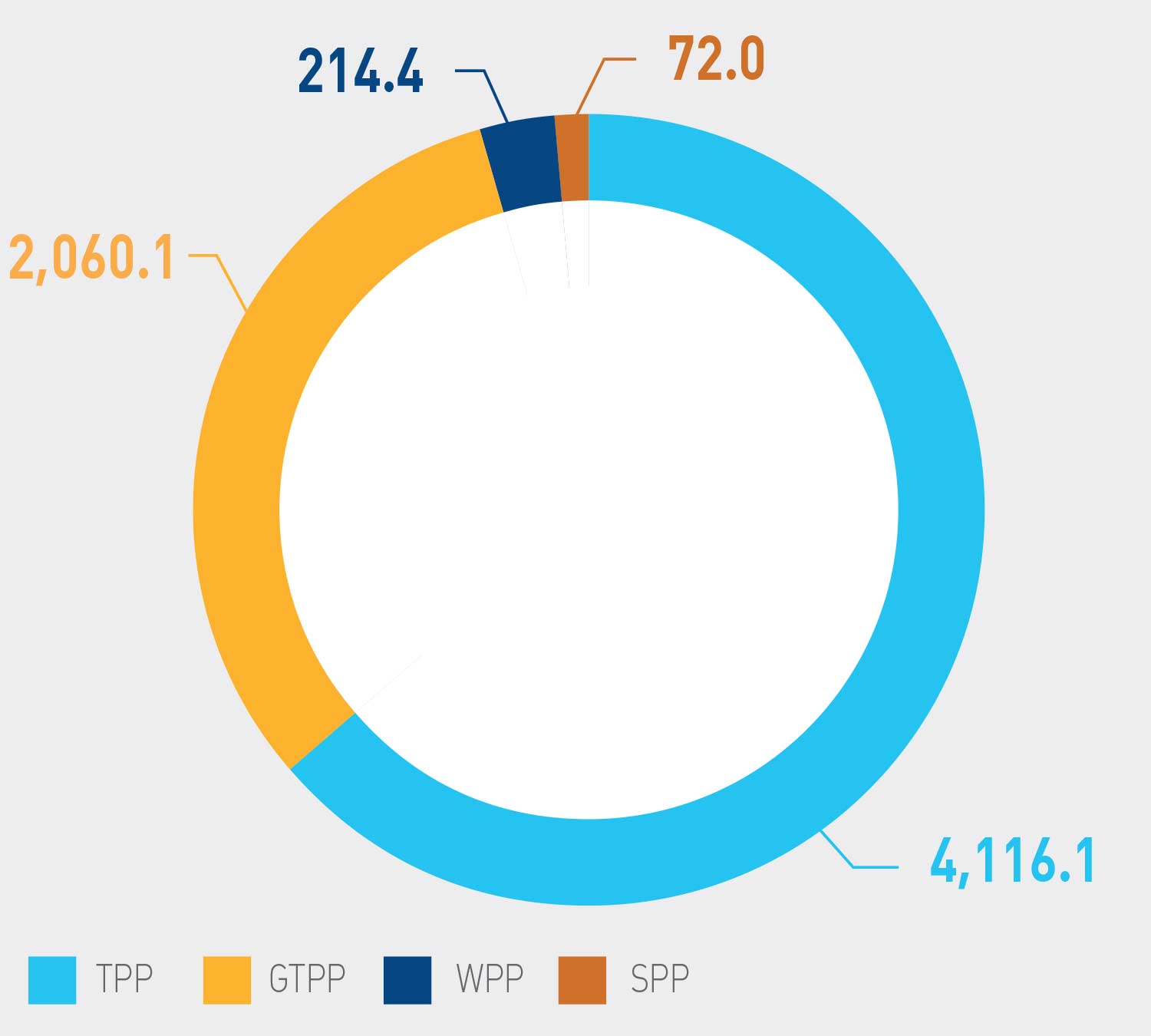
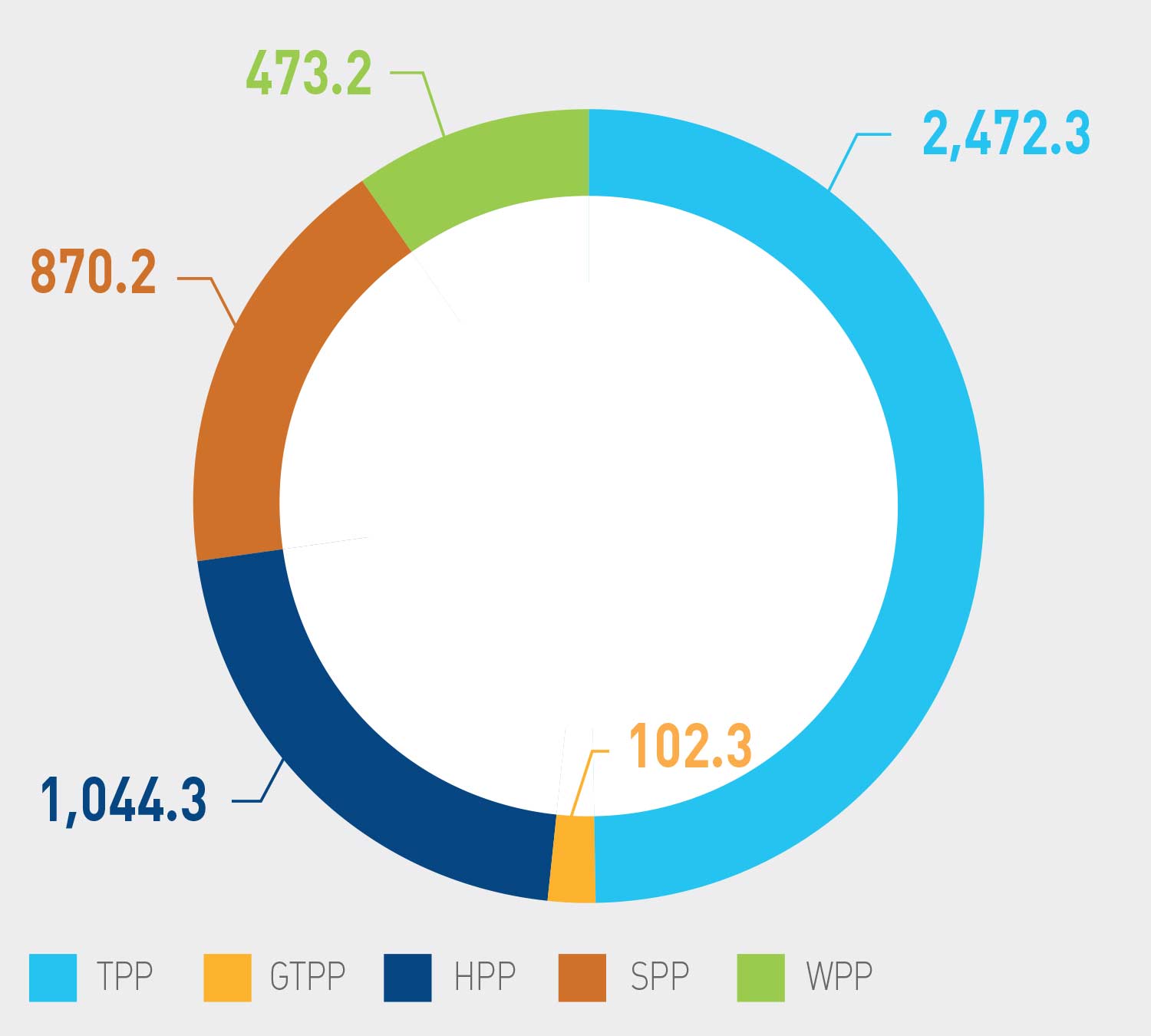
Installed capacity of power plants by zones, MW
Installed capacity of power plants by zone
Northern zone
Western zone
Southern zone
In 2025, 1,492.8 MW of new generating capacity was commissioned, with an installed capacity of:
Installed capacity of power plants broken down by region
| Power plants | Installed capacity, MW |
|---|---|
| Aktobe Region: | 237.5 MW |
| WPP Khromtau, LLP KEZ | 137.5 |
| WPP Darmen Shuak, Darmen Shuak LLP | 50 |
| WPP Next Green Energy, Next Green Energy LLP | 50 |
| Almaty Region: | 2 |
| SPP Almatinskaya, LUKOIL-Ecoenergo Kazakhstan LLP | 2 |
| Atyrau Region: | 690 |
| Atyrau CHPP installation of steam turbine No.6 | 65 |
| TGTPP-4 TCO | 625 |
| East Kazakhstan Region: | -1 |
| At Sogrinskaya CHPP, on the basis of letter 02-1201 of 29.10.2025, the capacity is reduced by 1 MW. | -1 |
| Zhetysu Region: | 64.1 |
| The CCPP Tekeli, Tekeli Energy Complex LLP, was commissioned | 36 |
| The HPP-3, Korinskaya HPP-2 LLP, was commissioned | 26 |
| The gas-piston power plant, Baskuat Energoprom LLP, was commissioned | 2.1 |
| Karaganda Region: | 237.8 |
| KGRES-2 installation of steam turbine No.3 | 130 |
| WPP Hyperborea, Hyperborea LLP | 107.8 |
| Kostanay Region: | 53.2 |
| SPP, Kunshuak-2025 LLP | 3.2 |
| WPP Aspan, Aspan Energo LLP | 50 |
| Ulytau Region: | 101.2 |
| SPP Zhez-Solar, Zhezkazgan Metal Structures Plant LLP | 1.2 |
| WPP Zhezkazgan, Mezgilder Qushteri LLP | 100 |
| Zhezkazgan CHPP dismantling of TG No.5 | -42 |
| Kyzylorda Region: | 60 |
| SPP Shieli-1, Vigor Holding LLP | 20 |
| SPP Tesis, Tesis LLP | 40 |
| Kyzylorda CHPP-6 dismantling of TG No.6 | -42 |
| Mangystau Region: | 120 |
| WPP Zhetybay, Sarkylmas Kuat LLP | 50 |
| SPP Zhanaozen, Mangistau Renewables B.V. Branch | 50 |
| SPP Shetpe, Stellar Energy | 20 |
| West Kazakhstan Region: | 12 |
| Uralsk CHPP installation of steam turbine | 12 |
Electric energy transmission sector
The electric grids of the Republic of Kazakhstan represent an extensive set of substations, switchgear and power transmission lines of voltage from 0.4 to 1,150 kV, intended for the transmission and/or distribution of electric energy from producers to consumers. Within this infrastructure, the National Power Grid (NPG) is of particular significance, as it performs the role of the system-forming grid in the Unified Power System of the Republic of Kazakhstan.
The National Power Grid provides the electrical connections between the regions of the Republic of Kazakhstan, forming the country’s unified, synchronously operating energy system, and also provides interstate electrical connections with the energy systems of neighbouring states – the Russian Federation, the Kyrgyz Republic and the Republic of Uzbekistan. In addition, the feed-in of electric energy by power plants and its transmission to wholesale consumers is carried out through the NPG, which makes this infrastructure a key element of the reliable electricity supply of the country’s economy.
The substations, switchgear, and inter-regional and/or interstate power transmission lines and power transmission lines intended for the feed-in of electric energy of power plants, of voltage 220 kV and above, which form part of the National Power Grid, are on the balance sheet of KEGOC JSC. The Company carries out their operation, maintenance and development, ensuring the reliable transmission of electric energy on the scale of the entire country and beyond its borders.
Regional-level electric grids provide the transmission of electric energy within individual regions of the Republic of Kazakhstan, as well as the delivery of electricity to retail consumers. These grids are on the balance sheet of and operated by regional electric grid companies, which are responsible for the functioning of the distribution infrastructure on the ground.
The transmission of electric energy within the wholesale and retail markets is carried out by power-transmitting organisations on a contractual basis. Such organisations provide the transmission of electric energy through their own electric grids or grids used under the rights of lease, leasing, trust management or other lawful forms of use, providing services to consumers of the wholesale and retail markets, as well as to energy-supplying organisations.
Thus, KEGOC JSC acts as the central link of the electricity transmission sector of the Republic of Kazakhstan, ensuring the functioning of the National Power Grid, the integration of regional and interstate energy systems, and the resilience and reliability of the country’s Unified Power System as a whole.
Wholesale electricity market
The wholesale electricity market of the Republic of Kazakhstan functions on the basis of a model established by legislation and brings together the key participants in the electric power industry that ensure the production, transmission, purchase and sale, and balancing of electric energy within the country’s Unified Power System.
Entities of the wholesale electricity market
As of the end of 2025, the entities of the wholesale electricity market are:
- power-generating organisations;
- power-transmitting organisations;
- energy-supplying organisations;
- consumers of electric energy, purchasing electricity on the wholesale market in a volume of at least 1 MW of average daily (base) capacity, including digital miners and administrators of hybrid groups;
- the system operator, whose functions are performed by KEGOC JSC;
- the operator of centralised trade in electric energy and capacity, whose functions are performed by KOREM JSC;
- the Single Buyer of electric energy – RFC for RES LLP.
The list of entities of the wholesale electricity market is formed and maintained by the system operator in accordance with the requirements of the legislation of the Republic of Kazakhstan.
Wholesale market operating model
Within the existing wholesale market model, the Single Buyer of electric energy carries out, on an ongoing basis, the centralised purchase of electric energy from power-generating organisations and its subsequent sale to wholesale consumers in the volumes included in the daily schedule of electricity production and consumption.
The financial settlement of deviations of the actual volumes of production and consumption from the planned values (imbalances) in the Unified Power System of the Republic of Kazakhstan is carried out on the balancing electricity market, the operator of which is the settlement centre of the balancing market. The balancing market continues to perform the key function of ensuring the economic and technological balance of the energy system.
Under the existing wholesale market model, the absence of “addressability” of the distribution of electric energy is maintained, as well as the absence of the technical capability to determine the specific routes of electricity supply from the producer to the end consumer. In this connection, in accordance with the Law of the Republic of Kazakhstan “On the Electric Power Industry”, the service for the use of the National Power Grid continues to apply, which is provided by the system operator to wholesale market entities when carrying out the purchase and sale of electric energy from the Single Buyer, and also when participating in the balancing market.
The role of KEGOC JSC in the wholesale market
Within the existing and continuing-to-develop wholesale market model, KEGOC JSC performs the following main functions:
- provides system services, necessary to ensure the reliable and stable operation of the energy system;
- is the holder and operator of the modernised hardware and software complex of the balancing market system, which continues to serve as the main tool for managing the balancing electricity market;
- carries out the physical settlement of imbalances in the energy system by engaging the price bids of market entities from a ranked list, and also within the framework of the existing contractual relations on the settlement of deviations with the energy systems of the Russian Federation and the countries of Central Asia.