



Risk management and internal control system
KEGOC JSC has successfully implemented and operates a risk management system that has been formed on the principles of the international standards ISO 31000 and on the basis of generally accepted conceptual risk management models developed by the Committee of Sponsoring Organisations of the Treadway Commission – COSO ERM “Enterprise Risk Management. Integrated Model”, and the requirements of Samruk-Kazyna JSC.
The corporate risk management system is a key component of the corporate governance system, aimed at the timely identification of risks, their assessment, monitoring and management of key corporate risks, as well as the integration of a risk-based approach into the strategic and operational processes of the Company.
The primary objective of the existing Corporate Risk Management System (CRMS) is to ensure continuity and stability of operations by limiting the impact of internal and external negative factors on KEGOC JSC’s activities.
The core principles of the risk management system include:
- engagement of the Company’s management in the risk management process;
- continuous improvement of the risk management system;
- ongoing training and knowledge-sharing in risk management among employees;
- transparency and honesty in risk reporting and escalation.
The tasks of the risk management system are:
- development and application of uniform and consistent approaches to identifying, assessing, and managing KEGOC JSC’s risks, simplifying vertical (management) and horizontal (experience sharing) risk communication processes;
- prompt response to emerging risk events, tracking changes in external and internal environments;
- targeted risk management activities to reduce risks to an acceptable level or to transfer them to third parties (outsourcing, insurance, hedging) or avoid them altogether;
- systematization and accumulation of risk data at KEGOC JSC to enhance the Company’s manageability;
- improving KEGOC JSC’s competitiveness and achieving its strategic goals by enhancing the efficiency of the CRMS.
The CRMS serves as a tool to support managerial decision-making and day-to-day operational activities at KEGOC JSC.
The risk management process at KEGOC JSC is continuous, cyclical, and multidirectional, and includes the following components:
- Internal environment;
- Objective setting;
- Risk identification;
- Risk assessment, including determination of risk appetite;
- Risk management, including determination of key risk indicators and the level of tolerance;
- Control activities;
- Information and communication
- Monitoring.
KEGOC JSC Risk Management Process
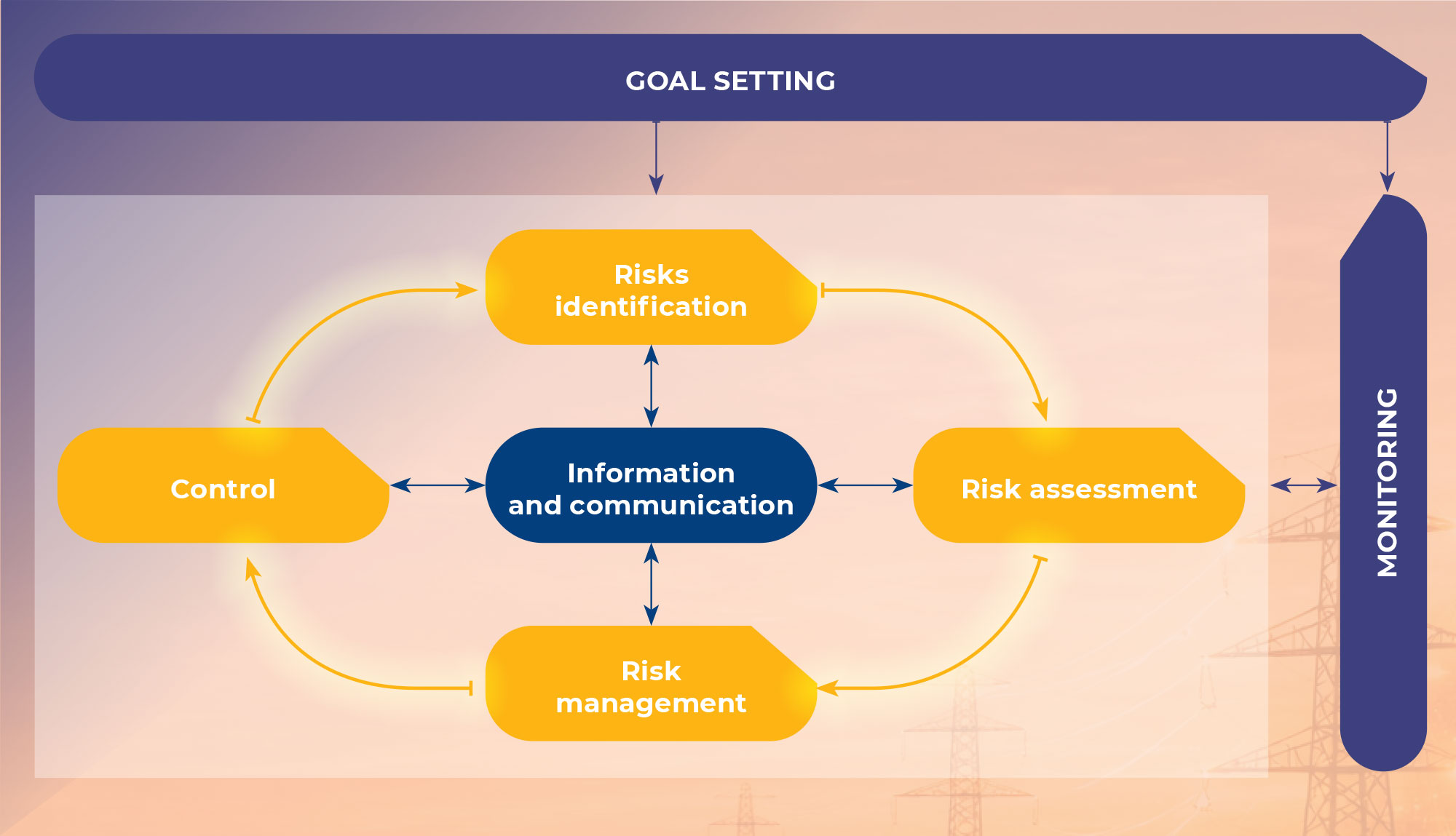
Implementation of the above components of the risk management process contributes to the development of risk management culture (risk culture), which is the basis of risk management. It comprises beliefs, understanding and knowledge in the field of risk management, shared and applied by all officers and employees in the performance of their duties.
Risk culture is part of the corporate culture. The level of risk culture determines how risks are identified, assessed and managed from the development of the Development Plan through to its implementation and performance monitoring.
The risk culture is based on the following principles:
- Tone at the top: Decision-making is based on an optimal balance between long-term value, profitability and the risks associated with both making and not making decisions, and management encourages risk-oriented behavior in subordinates.
- Corporate Governance: KEGOC JSC activities are aimed at creating a control environment that ensures that employees understand that the Policy and all IRDs are binding. All officers and employees of KEGOC JSC clearly recognize their area of responsibility and authority for risk management and internal control. Risk Owners, within the scope of their competence, understand and manage risks and properly communicate risks in accordance with KEGOC JSC INEDs.
- Decision-making: The internal environment is characterized by open communication and transparency of risk information, which facilitates open and constructive discussion of associated risks and potential opportunities between employees and management, allowing for joint effective decision-making in response to external challenges.
- The remuneration system at all levels uses financial and non-financial incentives for management and employees to form the right attitude to risk in the process of making managerial decisions. With a well-developed risk culture, decisions are clearly defined by the Risk Appetite.
- Competence: KEGOC JSC organizational structure is based on the ‘three lines of defense’ model. The Risk Unit effectively fulfils the role of the second line of defense, thereby increasing Management’s confidence in achieving KEGOC JSC objectives.
One of the sources of information on the level of risk culture for the Management Board and the Board of Directors are documents on assessment of CRMS efficiency, reports on diagnostics of corporate governance in the Company.
In order to enhance risk culture, briefings/seminars are held in the Company for newly recruited employees in the area of the Company’s CRMS. Members of the Board of Directors and the Company’s management are required to participate annually in specialised seminars and trainings on risk management aimed at senior executives. This obligation is enshrined in the Company’s internal documents. Thus, in 2025, training was conducted for members of the Board of Directors and management on “Risk management: sanctions, financial and other risks”.
To control the level of risk culture development in the Company, in 2025, a questionnaire (survey) of employees/testing of knowledge in the field of CRMS was conducted to assess the effectiveness of risk management at the workplace. In addition, KEGOC JSC employees were tested on their knowledge of risk management and internal control systems, and all those tested passed successfully.

Organizational structure of the CRMS
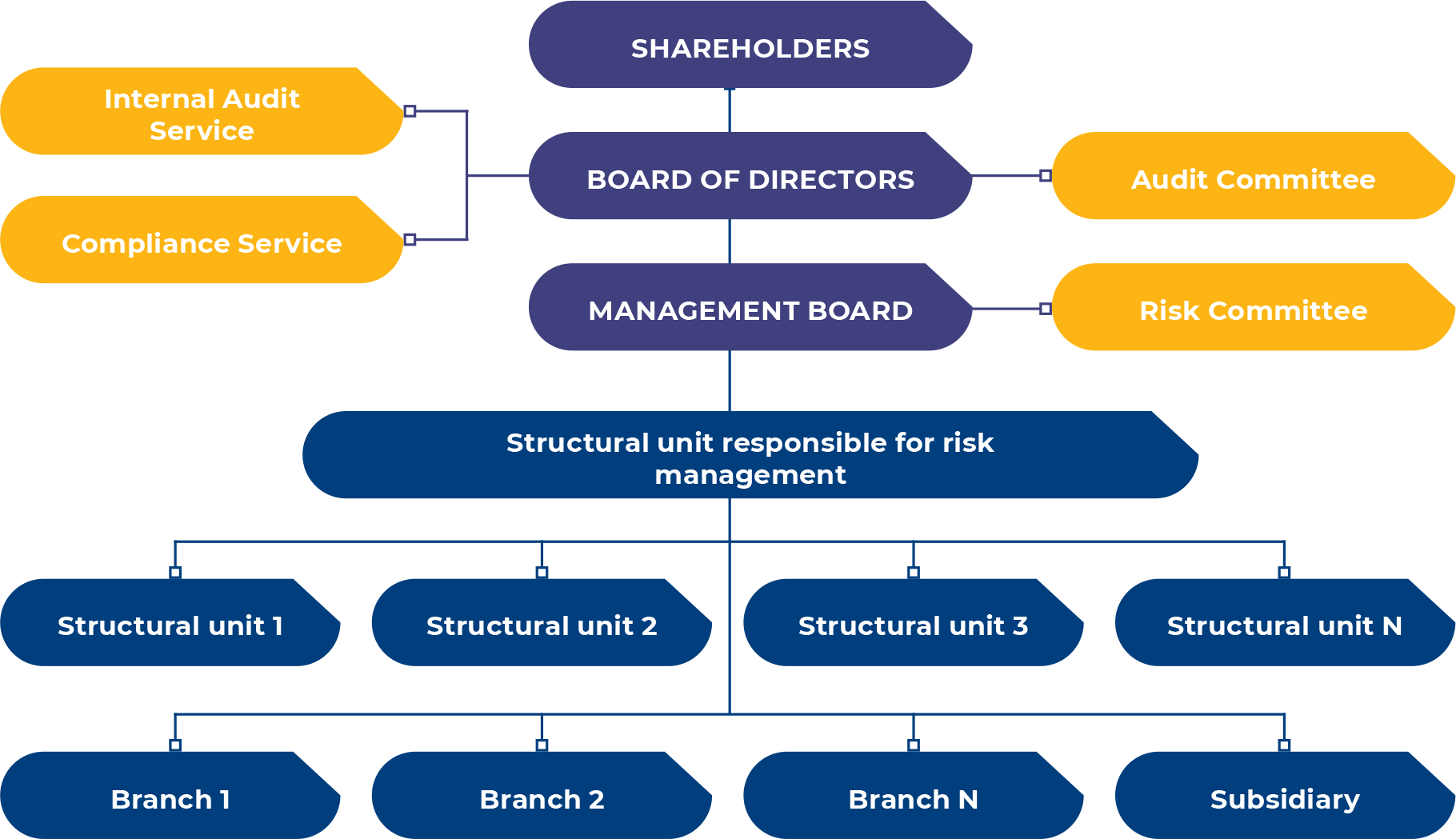
Functions and responsibilities of CRMS participants:
| CRMS participants | Functions and responsibilities |
|---|---|
| Board of Directors |
|
| Audit Committee; |
|
| Internal Audit Service |
|
| Management Board |
|
| Structural units, branches of KEGOC JSC and subsidiaries – risk owners |
|
| Compliance Service |
|
| Risk Committee |
|
| Structural unit responsible for risk management |
|
In performing their functions, the Board of Directors and the Management Board rely on the “Three Lines of Defence” model, which interacts within the CRMS.
The first line of defence is represented by structural units in the persons of individual employees within their competence.
The second line of defence is represented by structural units performing monitoring functions.
The third line of defence is represented by the Internal Audit Service, which conducts an independent assessment of effectiveness and assists in improving risk management and internal control, supports the Audit Committee and provides the Board of Directors with an independent assessment of the effectiveness of the CRMS and internal control.
Existing risks are analysed and new risks that may have a negative impact on the achievement of goals, objectives, indicators and the implementation of activities of the Development Plan (Strategy) of KEGOC JSC and the Action Plan (Business Plan) of KEGOC JSC are identified on a regular basis.
When identifying risks, the following methods are used:
- business process analysis;
- collection and analysis of statistical data;
- individual expert methods (questionnaires, interviews);
- group methods (brainstorming, business games);
- monitoring of publications and speeches.
Risks may also be identified when considering matters submitted to meetings of the Management Board and the Board of Directors, when changes occur in the external environment, and when processes, procedures, organisational structure and other elements change in KEGOC JSC.
When developing new technological services, digital systems and services, KEGOC JSC conducts a preliminary analysis covering regulatory, technical, ESG, legal and operational risks.
Risks are identified based on the current-year goals (KPIs) of Management Board members, management employees and heads of structural divisions, which are formed based on the strategic goals of KEGOC JSC.
During the risk inventory process, risks are assessed in parallel with determining approaches to managing these risks.During risk assessment, the following risk parameters are assessed:
- risk impact (size);
- probability of occurrence (frequency);
- time of impact.
Risk assessment uses qualitative or quantitative analysis, or a combination of them, including analysis of:
- geographical factors;
- industry specifics;
- sensitivity;
- stress testing for financial and operational risks, etc.
The assessment of the probability of risk occurrence, impact and time horizon of impact is carried out in accordance with the risk assessment criteria established by KEGOC JSC. The results of the risk assessment process are plotted on the Risk Map, which clearly shows the relative significance of each risk. Risks are ranked as low, medium, major and critical.
Preventive and reactive measures are developed for all identified risks and approved by the Board of Directors. Measures to manage key risks are aimed at preventing risks and/or minimizing consequences in the event of risk occurrence.
All identified risks, including their assessment and measures, are approved by the Board of Directors following prior review by the Management Board and the Audit Committee.
Classification of KEGOC JSC Risks
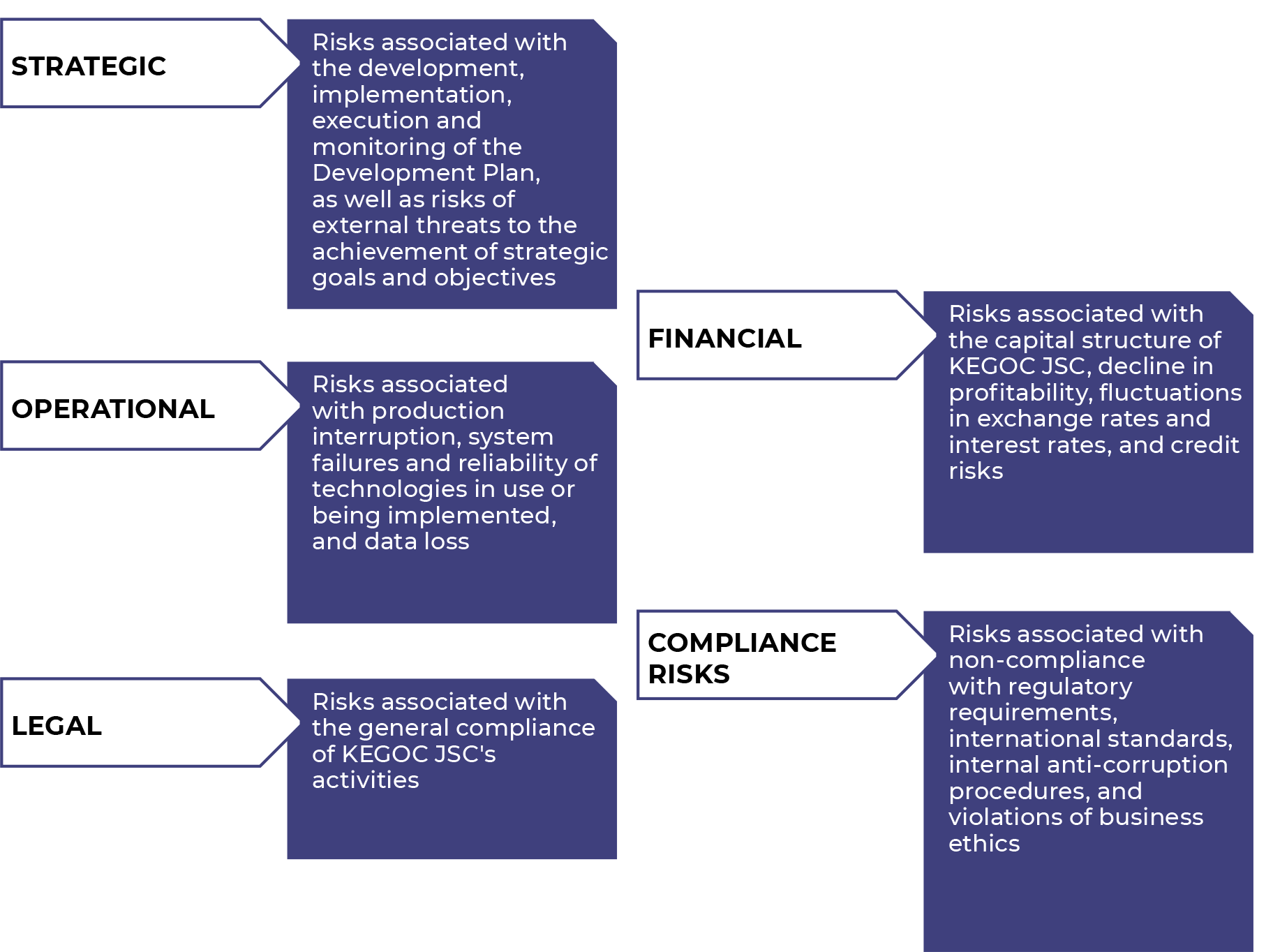
The results of risk identification and assessment were consolidated in the Company’s Risk Register for 2025, which included 49 risks. Management measures were developed for each risk and risk owners were identified. The Company continuously monitors the dynamics of key risks and the implementation of mitigation measures by submitting quarterly risk reports to the Management Board and the Board of Directors of the Company.
Risk map of KEGOC JSC
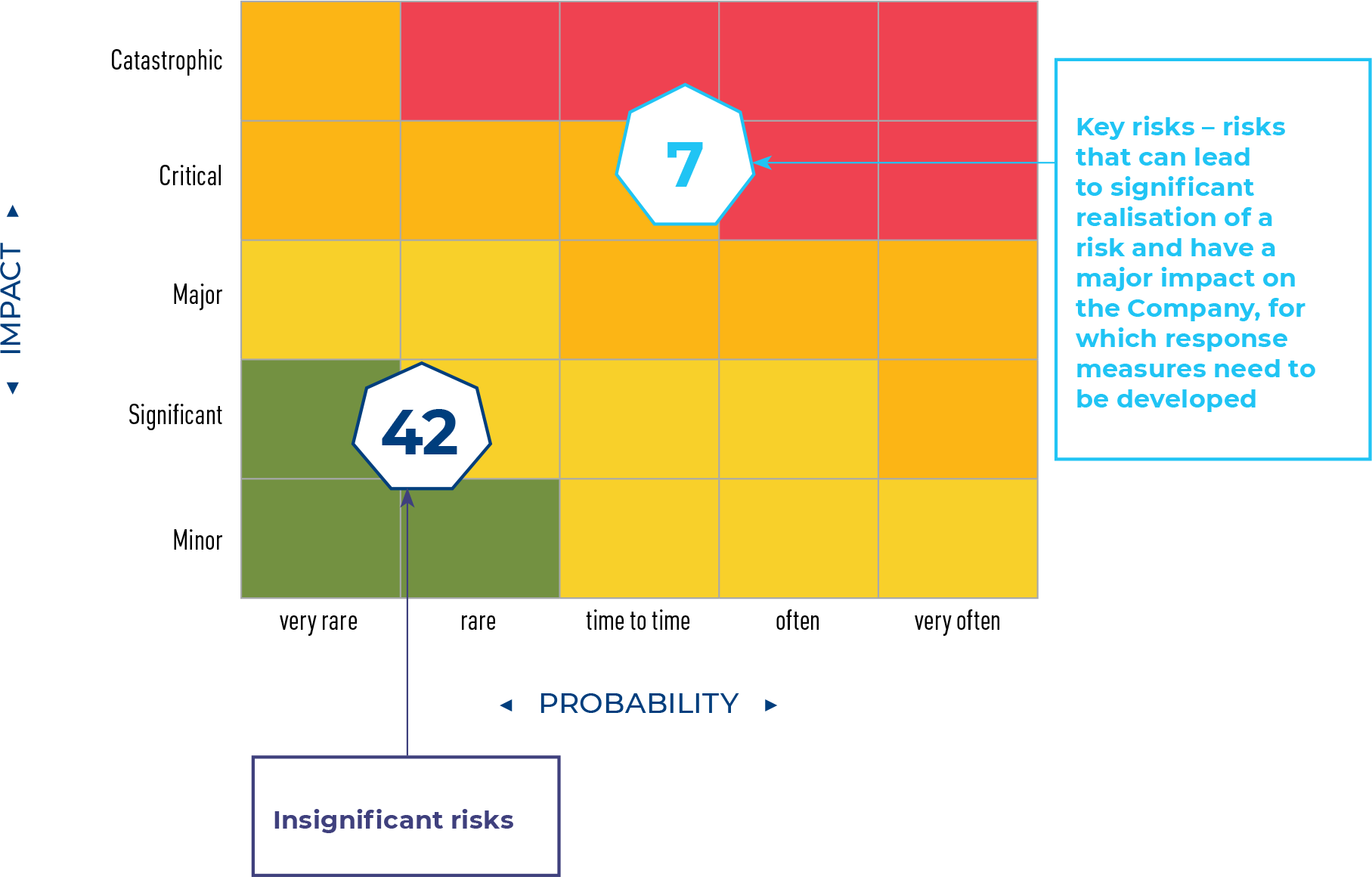
All material topics identified based on the ESG materiality assessment were mapped against key corporate risks and included in the risk register. Material topics are used as input data for the annual cycle of risk identification and prioritization.
The most important and relevant risks of KEGOC JSC for the reporting year are:
| Name of risk | Risk factors | Measures |
|---|---|---|
| Risk of occurrence of an accident related to labour activity |
|
|
| Risk of growth of overdue receivables for system services rendered |
|
|
| Risk of occurrence of accidents and first-degree failures |
|
|
| Information security risk |
|
|
| Risk of non-fulfilment of the investment programme specified in the Action Plan (Business Plan) |
|
|
| Risk of occurrence of a capacity shortage in the Southern zone of the UPS of Kazakhstan |
|
|
| Decline in the Company’s share price below the SPO offering price |
|
|
More detailed information on the management of key risks is disclosed in the relevant sections of this report by areas of activity and implementation of the Company’s strategic goals.
Emerging risks
In addition to the main risks, the Company considered emerging risks that are at the stage of identification and/or may significantly increase in the future and are capable of having a material impact on the Company’s activities and potentially having a long-term (3–5 years) material impact on its activities.
| Name of emerging risk | Risk associated with artificial intelligence | Risk of NPG instability due to accelerated growth of RES and distributed generation |
|---|---|---|
| Category | Operational risk | Operational risk |
| Описание | The risk associated with the implementation and operation of AI at KEGOC JSC may be caused by HR, organizational, technological and legal factors. These include the shortage of qualified specialists and personnel training, the absence of internal policies and distribution of responsibility, incorrect integration of AI into business processes, erroneous or non-transparent algorithms, the use of poor-quality or distorted data, and failures in non-standard modes of operation of the power system. Cyber threats (attacks, data substitution, leaks) and risks of violating legislation on personal data and intellectual property are significant, as is the uncertainty of legal liability for AI decisions. | The accelerated growth of RES and distributed generation creates for KEGOC JSC, as the system operator of the UPS of Kazakhstan, a risk of reduced stability and manageability of the NPG. The variable and weather-dependent output of RES complicates the balancing of electricity production and consumption in real time, increasing requirements for capacity reserves and frequency and voltage regulation systems. The connection of new facilities may lead to overloading of the network, reduced inertia of the power system and an increased probability of technological violations. Additional challenges relate to the limited throughput of the network infrastructure and the need to modernize forecasting and dispatch control systems. |
| Impact | Potentially: reduction in the reliability of management of the Unified Power System of Kazakhstan, the occurrence of operational failures and growth of technological risks; financial losses, including additional costs for elimination of consequences of incidents and penalty sanctions from regulatory authorities; cyber incidents, leakage of sensitive information and data compromise; court disputes and regulatory restrictions in case of non-compliance with legal requirements; reputational losses, reduction of trust on the part of the state, investors and other stakeholders. | Potentially: an increase in the number of technological violations, frequency and voltage deviations and an increased load on dispatcher services; growth of operating costs for maintaining capacity balance, attracting reserves and providing system services; the need for additional capital investments in the modernization and development of network infrastructure and digital forecasting and operating mode management systems; possible restrictions on the connection of new generation facilities and a decline in the quality of electricity supply, which could affect financial indicators, investment plans and the level of trust from the state and other stakeholders. |
| Mitigation actions |
|
|
The Internal Control System of KEGOC JSC (ICS) uses the COSO model and includes five interrelated components: control environment, risk assessment, control activities, information and communications, monitoring.
The Internal Control System Policy of KEGOC JSC defines internal control as a process carried out by participants in the internal control system with the aim of achieving the set objectives in three key areas:
- operational activities;
- preparation of financial statements;
- compliance with regulatory and legal requirements.
The ICS provides for the Company to build a management system capable of responding quickly to process risks, exercising control over core and supporting business processes and daily operations, and providing immediate information to management at the relevant level on any material deficiencies and areas for improvement.
In accordance with the Regulations on the Organization and Conduct of Work on the Internal Control System of KEGOC JSC, the competences of the bodies forming part of the ICS are delineated, depending on their role in the processes of developing, approving, applying and assessing the effectiveness of the ICS. The Board of Directors and the Management Board of the Company, in performing their functions, rely on the “Three lines of defence” model. Participants in the ICS are the Board of Directors, the Management Board, the Audit Committee, the Internal Audit Service, structural units – business process and sub-process owners, performers of control procedures, and the structural unit responsible for risk management and internal control.
The Company regularly assesses the design of control procedures, within which an analysis of existing business processes is carried out.
This work includes the identification and assessment of process risks, analysis of internal regulatory documents and flowcharts, and assessment of the effectiveness of control procedures. Based on the results of the design assessment, the matrix of risks and control procedures is agreed and approved by the business process owner, and recommendations are issued for improving the business process.
The Internal Audit Service is responsible for the direct conduct of the assessment of the effectiveness of the ICS, testing of the operational effectiveness of control procedures, and the preparation and submission of the relevant reporting to the Audit Committee and the Board of Directors.
Annually, based on the Company’s business process register, the Company approves a control procedure design assessment plan, under which the effectiveness of control procedure design is analyzed. Based on this analysis, recommendations for improvement and areas for development are prepared.
The Company has implemented a business continuity system, under which business processes/subprocesses requiring the development of business continuity plans are identified. In 2025, work was carried out to determine critical business processes/subprocesses of the Company for which business continuity plans were developed and tested, in particular for the provision of system operator services for technical dispatching, ensuring occupational safety and equipment reliability, providing and supporting ITC services, managing information security incidents and conducting KEGOC JSC activities during emergencies.
Annually, the Internal Audit Service of KEGOC JSC assesses the effectiveness of the CRMS and ICS and submits the assessment to the Company’s Board of Directors. According to the assessment conducted by the Internal Audit Service in 2025, the internal control and risk management systems function in an acceptable form that provides reasonable assurance of achieving the Company’s goals. For all identified non-compliances, relevant corrective action plans were developed based on IAS recommendations, and their implementation is monitored on an ongoing basis.