Research and development
The activity of R&D management in the Company is regulated by the relevant internal documents, which establish uniform requirements for the organisation, planning, accounting, execution control and acceptance of R&D carried out at the request of KEGOC JSC. R&D is regarded as a process covering the entire life cycle, from the definition of tasks to the assessment and accounting of the actual effect of the use of development results in the Company’s practical activities.
R&D in the Company is aimed at achieving the Company’s strategic goals in accordance with the KEGOC JSC Development Plan and the KEGOC JSC Innovation and Technology Policy.
The main objectives in organising R&D in the Company are:
- the creation, systematisation and development of processes for the planning and execution of R&D, taking into account its priority and relevance for the innovation and technological development of the Company;
- ensuring the effective interaction of processes related to the development and use of scientific and technical products;
- the implementation of R&D results to enhance the efficiency and quality of production and business processes;
- monitoring of the achievement of target indicators.
The main areas of technological development of KEGOC JSC are:
- innovation;
- R&D;
- rationalisation and invention activities.
Indicators of technological development of KEGOC JSC over the last 5 years
| 2021 | 2022 | 2023 | 2024 | 2025 | |
|---|---|---|---|---|---|
| Total costs, KZT million, including for: | 236.97 | 3.72 | 15.09 | 56.75 | 14.31 |
| Innovation | 215.50 | – | – | – | – |
| R&D | 19.80 | – | – | 43.55 | – |
| Rationalisation activities | 1.67 | 3.72 | 15.09 | 13.20 | 14.31 |
| Number of employees engaged in research activities, persons | 26 | 26 | 26 | 26 | 26 |
Implemented projects of technical and economic studies (TES), research (R) and experimental design (D) work
| № | Name of the project | Years of implementation |
|---|---|---|
| 1 | R&D on the reduction of electricity losses in 500 kV transmission lines with OPGW | 2017–2020 |
| 2 | R&D “Investigation of the effectiveness of AVR settings of system electrical stations to ensure the static and dynamic stability of 500-220 kV NPG of the Republic of Kazakhstan” | 2018–2022 |
| 3 | TES on the development of algorithms and the creation of WACS automation on the basis of synchrophasor measurements WAMS | 2019–2020 |
| 4 | R&D on the determination of the factors and source of contamination of the insulation of electrical equipment of the Western MES | 2021 |
| 5 | TES on the possibility of using electricity storage systems for the UPS of the Republic of Kazakhstan | 2021 |
| 6 | TES on digital SS technologies | 2021 |
| 7 | TES on the selection of FACTS devices for the compensation of reactive power in the UPS of the Republic of Kazakhstan | 2021–2022 |
| 8 | TES on the need for the earthing of the shielding sheaths of control cables at substations with microprocessor-based RPA devices | 2023–2024 |
| 9 | R&D on the development of a robot for cleaning conductors of contamination | 2025–2026 |
| 10 | R&D on the development of a laboratory prototype of hydrophobic-water-repellent coatings for overhead-line conductors that prevent the adherence of water and ice | 2025–2026 |
In 2025, as part of the “Samruk Innovation Hub” competition initiated by the “Samgau” Centre for Scientific and Technological Initiatives, the implementation of the following R&D projects has begun:
- Development of a laboratory prototype of hydrophobic-water-repellent coatings for overhead-line conductors that prevent the adherence of water and ice – Kazakh-British Technical University JSC.
- Development of a robot for cleaning conductors of contamination – K. I. Satpayev Kazakh National Research Technical University NJSC.
Also, as part of R&D activities in 2025, competitive applications for grant funding from the Ministry of Science and Higher Education of the Republic of Kazakhstan have been submitted for the following research projects:
- Research and development of technical methods to reduce electricity losses during long-distance transmission – in cooperation with G. Daukeev Almaty University of Power Engineering and Telecommunications NJSC.
- Development of requirements for RES under conditions of their growth to maintain inertia in the power system – in cooperation with Abylkas Saginov Karaganda Technical University NJSC.
Rationalisation and invention activities
Rationalisation and invention activities (RIA) are carried out in accordance with the “Rules for the organisation of rationalisation and invention activities at KEGOC JSC and its subsidiary”.
The main advantage of RIA is the possibility of every employee participating in this process, which in turn makes it possible to maximally shorten the time from the birth of an idea to its implementation and to cover the maximum number of Company employees.
As part of RIA, ideas with the potential for application in other Company divisions are identified, and conditions for scaling the proposal are provided. The main objectives in organising RIA are:
- energising RIA and the further development of mass technical creativity among employees of the Company and the subsidiary;
- increasing the interest of employees of the Company and the subsidiary in the results of their work through moral and material incentives for RIA.
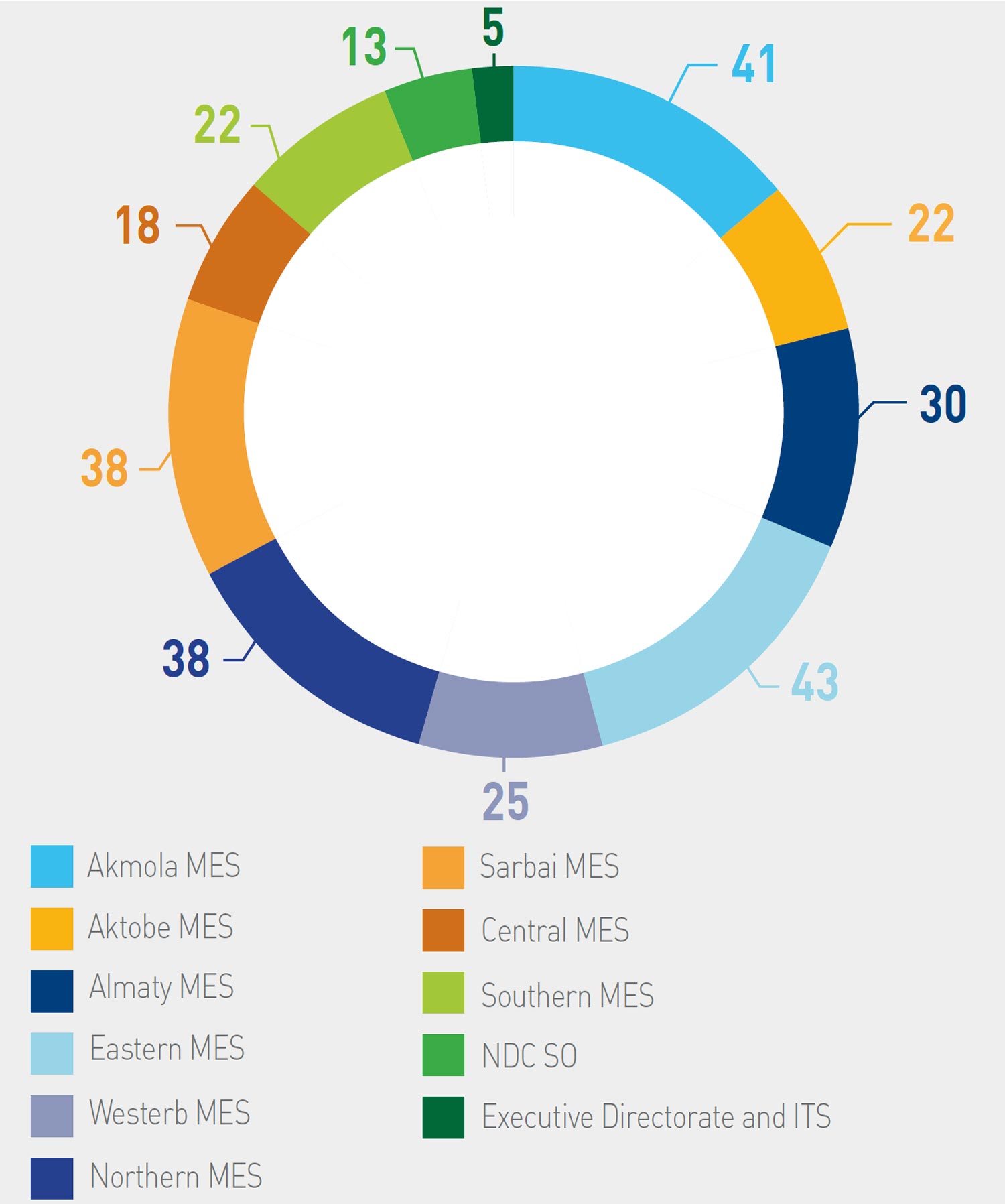
In 2025, 17 applications were recognised as rationalisation proposals, and remuneration for rationalisation proposals was paid in the amount of KZT 14. 312 million.
In total, for the period 2013–2025, 295 rationalisation proposals have been registered at KEGOC JSC.
Registered rationalisation proposals at KEGOC JSC for the period 2013–2025
Innovation
In line with the global trend, KEGOC JSC continues work in the area of modern innovation and digital technologies, the basis of which is the implementation of various elements of intelligent management of grid facilities (measurement, monitoring, control and management systems), on the basis of which next-generation electrical networks – so-called “Smart Grids” – can be created.
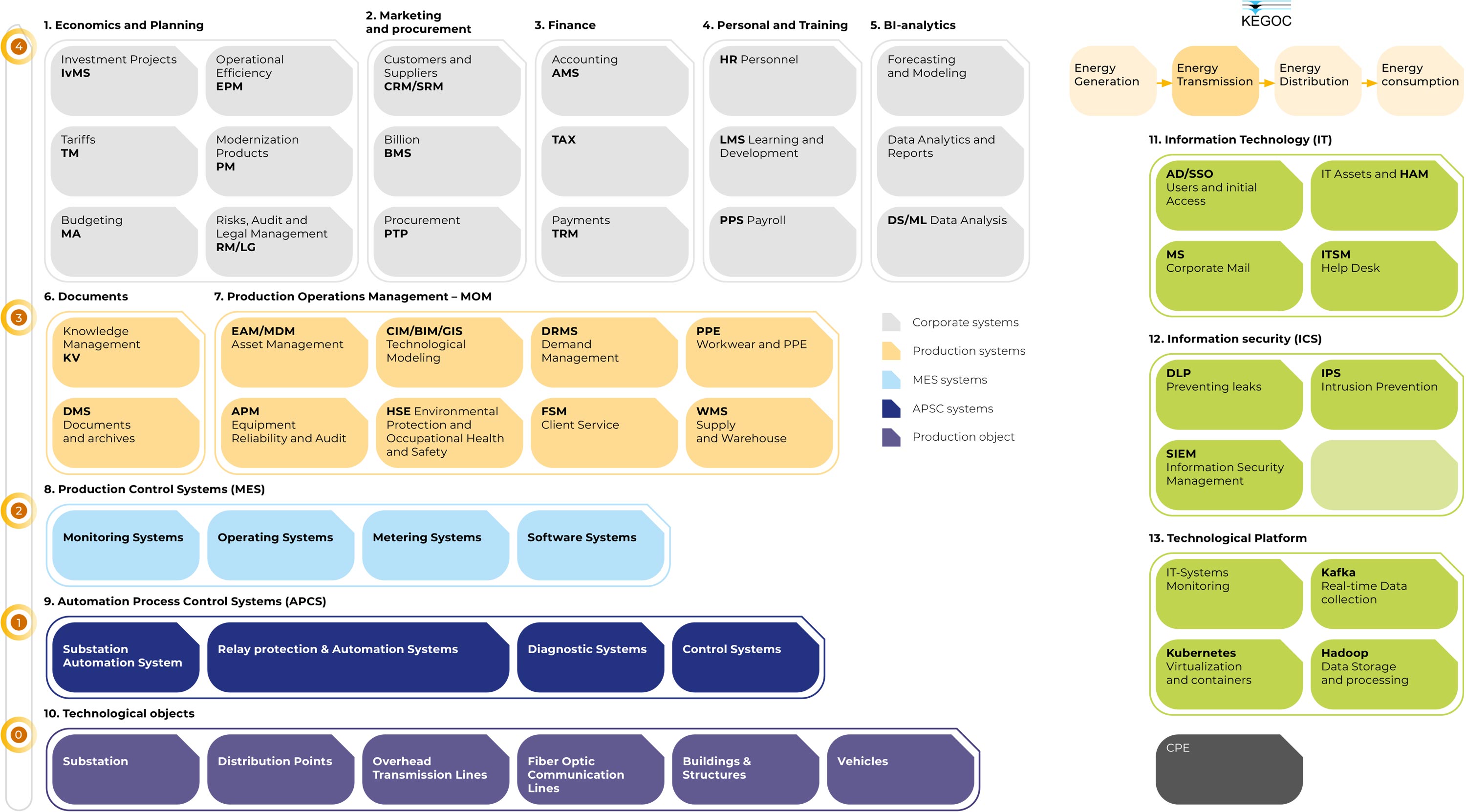
As part of these global trends, the “Concept for the Development of the Electric Power Industry of the Republic of Kazakhstan for 2023–2029” sets an indicator for the creation of an “Intelligent Power System”. This system will provide data collection and processing, decentralised management of energy systems, the integration of distributed generation including RES, decision-making based on synchrophasor measurements and the introduction of FACTS devices. To implement the Concept, the Ministry of Energy of the Republic of Kazakhstan has developed a technology architecture for all structures of the country’s fuel and energy complex (FEC).
In 2025, the implementation of the pilot project “Deployment of energy storage systems in the UPS of the RK” continued, to study the influence of electricity storage systems on the regulation of the UPS during RES integration, in cooperation with China Power International Development Limited, China Power International Holding Limited and the Renewable Energy Association of Kazakhstan AoLE. As part of the pilot project, it is planned to install an electricity storage system with a capacity of 3.45 MW and an energy capacity of 7.72 MWh.
Architecture of FEC digital information systems
In 2025, work was initiated on the implementation of the following pilot projects:
- Diagnostics of electrical installations using unmanned aerial vehicles and forecasting of technological violations.
- Development of a centralised system for monitoring the technical condition of power transformers, autotransformers and shunt reactors.
SASB IF-EU-420a.2
The Company has implemented information systems such as SCADA, AGC, CSPA, WAMC, WACS, AMR, M&C, FOCL, BEMS, BIS. Among them, the 100 % implementation of the AMR technology should be particularly noted.
KEGOC JSC, as part of the implementation of the “Smart Grid” Intelligent Power System concept, has identified three main directions for the digitalisation of production processes, which correspond to the Digital Information Systems Architecture of the FEC:
- Manufacturing Operations Management (MOM) – aimed at enhancing the reliability and efficiency of production operations, minimising downtime and optimising resources.
- Manufacturing Execution Systems (MES) – provide monitoring, accounting and management of production processes in real time, including the management of energy systems and process monitoring.
- Automated process control systems (APCS) – automation and control of technological processes, including substation systems, relay protection, diagnostics and emergency automation.
In the three areas above, in 2025 the implementation of projects continued: the modernisation of the SCADA/EMS system, the deployment of the monitoring system based on synchronised WAMS technologies (Phase 2), and the implementation of the project to expand the WACS management system has begun. These projects make it possible to enhance the effectiveness of dispatch management and the observability of the operating modes of the UPS of the RK, to ensure the monitoring of stability reserves and the assessment of the state of the UPS of the RK, and to expand the functions of emergency control.
In December 2025, work on the project “Deployment of the monitoring system based on synchronised WAMS technologies (Phase 2)” was fully completed. As part of the project, 59 monitored connections of WAMS were connected (across 7 MES branches at 21 substations). The expansion of the system will enable the improvement of the effectiveness of dispatch management of the UPS of Kazakhstan through the receipt of reliable data from additional synchronised vector measurement devices, and will also ensure the state estimation and stability-reserve monitoring of the UPS of Kazakhstan.
Artificial intelligence technologies
Artificial intelligence (AI) technologies open up new opportunities for the energy industry, becoming a key element of the digital transformation of energy systems. AI serves as an effective tool for addressing pressing tasks such as RES integration, the increasing complexity of energy system management processes, and the need to enhance the reliability of energy supply.
In order to implement the strategically established tasks for the deployment of artificial intelligence technologies at KEGOC JSC, in 2025 Roadmaps were developed and approved, defining a phased approach to the formation and implementation of the Company’s AI initiatives.

In accordance with the approved KEGOC JSC Roadmap for the implementation of projects using artificial intelligence (minutes of the Board of Directors meeting dated 26 September 2025, extract No. 10), a portfolio of 7 key AI projects has been formed, aimed at enhancing the reliability of the National Power Grid, optimising its operating modes, reducing technological losses and deploying intelligent management technologies.
| № | Code Name in road map | Project Name | Objective | Implementation Period | Cost, KZT mln | Type of Effect |
|---|---|---|---|---|---|---|
| 1 | Digital Substation Astana |
Strengthening the external power supply scheme of Astana.
Construction of electric grid facilities |
Improving the reliability of electric networks | 2026-2028 |
71.20
(development of feasibility study) |
Economic |
| 2 | Power Flow Optimization (PLEXOS, Centralized system for automatic control of frequency and power flows) | Optimization of electric power flows in the Unified Power System (PLEXOS, implementation of the regulator in the Centralized Automatic Frequency and Power Flow Control System) | Reduction of electricity transmission losses in the NPG | 2026-2027 | By decision of the Architecture Committee of KEGOC JSC | Economic |
| 3 | WACS New Controller | Expansion of the WACS control system | Improving the efficiency of emergency control | 2026-2027 | 758.8 | Economic |
| 4 | WACS Capacity Forecast | Forecasting the maximum permissible power flows based on WACS | Improving reliability and operational efficiency | 2026-2028 | By decision of the Architecture Committee of KEGOC JSC | Economic |
| 5 | SCADA of the System Operator | Modernization of the SCADA/EMS system | Improving dispatch control efficiency | 2023-2026 | 3,525.0 | Qualitative |
| 6 | Centralized system for automatic control of frequency and power flows New Connections | Connection of additional regulating resources to the Centralized Automatic Frequency and Power Flow Control System | Integration of new flexible regulating resources into the process of balancing electricity generation and consumption | 2026-2029 | Costs to be incurred by power plants | Country-wide economic |
| 7 | CORE GRID AI | AI platform | Improving interaction efficiency | 2026-2030 | 748.0 | Country-wide economic |
At the same time, KEGOC JSC’s projects in the area of artificial intelligence have been included in the Roadmap of the Transformation Programme of the Sovereign Wealth Fund Samruk-Kazyna JSC, under which 5 of the Company’s AI projects have been approved.
| № | Code Name in road map | Project Name | Objective | Implementation Period | Cost, KZT mln |
|---|---|---|---|---|---|
| 1 | Computer Vision | Analysis of video materials related to work execution | Reducing the injury rate and improving the responsiveness to hazardous situations and actions | 2027-2028 | 482 |
| 2 | VR Technologies | Application of virtual reality technologies for training purposes | Improvement of production process efficiency | 2027-2028 | 285 |
| 3 | RES | Forecasting electricity generation from RES (pilot project) | Improving the accuracy of planned RES generation | 2024-2026 | ADB grant |
| 4 | Demand Management | Demand management and analysis of electricity consumption (pilot project) | Improving the efficiency of energy consumption management | 2025-2027 | EBRD grant |
| 5 | Smart GIS | Modernization of the geoinformation system | Improving asset management efficiency | 2026-2029 | 1,038 |
The implementation of AI initiatives at KEGOC JSC is carried out in stages, within the framework of the Roadmap, and provides for three interrelated stages:
- the formation of the regulatory, methodological and architectural foundation;
- the deployment and pilot operation of AI solutions;
- the scaling and integration of AI into key business and production processes.
This approach ensures the systematic and managed deployment of artificial intelligence technologies, as well as the implementation of the instructions given at the meeting under the chairmanship of the Head of State on issues of artificial intelligence development (11 August 2025), with respect to demonstrating practical examples of AI deployment with confirmed economic effect.
In 2025, in order to implement the KEGOC JSC Development Plan (Strategy) and the Roadmap, activities continued on the integration of AI technologies as part of the following projects:
- Modernisation of the SCADA system. Stage: commissioning works are underway. The AI technologies used are in the area of predictive analytics for forecasting electricity production and consumption, and for forecasting the technological consumption of electricity based on the analysis of weather data and power system operating modes;
- Expansion of the WACS management system. Stage: approved project and estimate documentation. The AI technologies used are in the area of the identification of hazardous modes of the UPS of Kazakhstan; the automatic selection of the location for the implementation of automatic load shedding from AGC depending on deviations from the planned consumption and generation balance.
- Optimisation of electricity flows in the NPG (Plexos, implementation of a regulator in the central system of AGC). At the end of 2025, work was started on the request for commercial proposals and the approval of technical requirements for the project implementation. The AI technologies used are in the area of decision-making autonomy, which will make it possible, using an AI-based expert system, to optimise the loading/unloading of power plants by identifying groups of plants that participate in the optimisation of losses in specific regions.